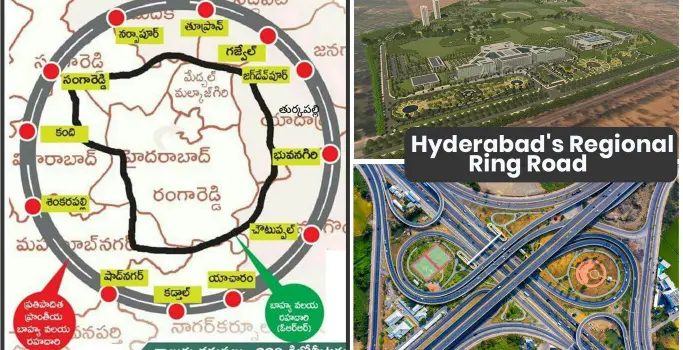
Hyderabad RRR 2025: Route Map, Investment Growth, and Real Estate Boom Unveiled
The city’s future is evolving with Hyderabad RRR 2025, unveiling route maps, investment growth, and a real estate boom set to transform regional development. This 340-kilometer access-controlled expressway is designed to loop around the city, strengthening regional connectivity, improving logistics, and opening up previously underutilized land for sustainable development. The RRR will link over 125 villages, integrate with major national highways, and fuel real estate demand in newly emerging zones, laying the groundwork for Hyderabad’s next phase of structured growth.
How Will the Regional Ring Road Reshape Hyderabad’s Growth?
The Regional Ring Road is a visionary infrastructure project planned as part of India’s national highway development, guided by NHAI under Bharatmala Phase 2. It is a response to mounting congestion along the existing Outer Ring Road (ORR) and aims to redirect long-haul traffic, boost inter-district connectivity, and stimulate economic activity in suburban areas.
Key Highlights:
- Length: ~340 kilometers
- Type: 4-lane, access-controlled expressway
- Budget: ₹17,000 crore
- Developer: NHAI
- Purpose: Reduce ORR load, enhance inter-city logistics, support peripheral urbanization
The RRR will bridge the existing urban-rural divide, unlocking underdeveloped corridors and transforming them into investment-grade growth zones.
Route Map – Northern and Southern Corridors
The RRR route is divided into two key segments to streamline implementation and enable phased development:
- Northern Corridor – Under Execution (158 km)
- Key Points: Bhongir, Narsapur, Gajwel, Toopran, Choutuppal, Sangareddy
- Districts: Sangareddy, Medak, Siddipet, Yadadri Bhuvanagiri
- Connected Highways:
- NH-161AA
- Rajiv Rahadari (SH 1)
- Warangal Highway (NH 163)
- Nagpur Highway (NH 44)
- Status: 94% of land acquired; construction actively underway
- Southern Corridor – In Planning (182 km)
- Key Points: Ibrahimpatnam, Chevella, Amangal, Choutuppal, Shankarpally
- Districts: Ranga Reddy, Sangareddy, Vikarabad, Nalgonda
- Connected Highways:
- Vijayawada Highway (NH 65)
- Bengaluru Highway (NH 44)
- Srisailam Highway (NH 765)
- Status: Land acquisition ongoing; construction tender yet to be issued
Why Hyderabad RRR Is a Game-Changer
✅ Seamless Connectivity Across Regions
The RRR will streamline movement across regional districts by connecting major and minor highways. It’s set to significantly reduce travel time between Hyderabad and key hubs such as Rajiv Gandhi International Airport, Gachibowli, and Kokapet, easing pressure on the core city zones.
✅ Strong Real Estate Catalysts
Several peri-urban localities are witnessing unprecedented growth owing to the RRR’s development push. Strategic connectivity, improved access, and policy-led planning are attracting both developers and end-users.
Emerging Investment Hotspots:
- Bhongir & Yadadri: Benefiting from religious tourism and Warangal corridor alignment
- Toopran & Gajwel: Seeing demand from institutional, industrial, and educational growth
- Chevella & Shankarpally: Experiencing land price surges due to proximity to financial districts and tech corridors
- Sangareddy: Evolving into a logistics and residential center with diversified economic base
Land Value Escalation Post RRR Announcement
Region | Before RRR (₹/sq. yd) | After RRR (₹/sq. yd) |
Bhongir | ₹3,900–₹5,700 | ₹12,000–₹16,000 |
Toopran | ₹2,600–₹4,500 | ₹7,800–₹11,000 |
Chevella | ₹3,200–₹5,500 | ₹9,600–₹12,900 |
These upward price shifts signal investor confidence and rising land absorption driven by RRR-linked infrastructure visibility.
Smart Townships & Entry of Godrej Regal Pavilion
To promote holistic regional growth, the state government is planning integrated smart zones along the RRR. These urban pockets will house IT parks, healthcare infrastructure, educational institutions, and transit-driven housing. Among the first movers in this region is Godrej Regal Pavilion, a luxury residential township that aligns with the RRR’s blueprint.
Strategically located to benefit from RRR-driven connectivity, Godrej Regal Pavilion offers Nawabi-inspired architecture, premium apartments, and proximity to Hyderabad’s next-generation infrastructure. Its positioning allows future residents to enjoy urban conveniences while remaining close to nature and upcoming job clusters.
Mid-2025 Project Status Overview
Task | Northern Corridor | Southern Corridor |
Land Acquisition | 94% Completed | In Progress |
Construction | Initiated | Awaiting Tender Process |
Environmental Clearance | Approved | Under Review |
Completion Target | 2026 | 2028–2030 (Estimated) |
Challenges to Monitor
- Land Compensation Concerns: Deliberations ongoing to address farmer compensation demands
- Material & Labour Cost Inflation: Delays contributing to rising project expenditure
- Ecological Impact: Forest route sections require green bridges and compensatory afforestation
What the Future Holds for RRR Zones
As construction scales up, Hyderabad’s RRR blueprint will be accompanied by new urban and economic enablers:
️ Logistics Hubs & Dry Ports – Especially in Choutuppal and Toopran belts
Twin Rail Corridors – Planned parallel to the expressway for freight mobility
️ Integrated Mixed-Use Zones – Housing, business parks, schools, and retail under one development
Surge in Rental Demand – Triggered by IT park developments and workforce migration
Conclusion
The Hyderabad Regional Ring Road (RRR) 2025 is more than just a highway—it is a vision-driven enabler of structured urban expansion, regional upliftment, and investment-led development. With groundwork already laid in the Northern Corridor and real estate pioneers like Godrej Regal Pavilion entering high-potential locations, Hyderabad is clearly charting a smarter, faster, and more inclusive growth trajectory.
For investors and homebuyers, aligning early with RRR-influenced zones isn’t just a smart move—it’s a future-proof strategy.